Contents
Exercise is one of the areas where French Bulldog ownership requires the most thought relative to most other breeds. Not because Frenchies need a lot of it, but because the right amount depends on the individual dog, the time of year, the temperature and the dog’s specific airway health. Getting it wrong in either direction, too much or too little, has real consequences.
What French Bulldogs were bred for
French Bulldogs were developed as companion animals, not working or sporting dogs. Their ancestry from the English Bulldog, bred for bull-baiting, left them with the compact, muscular build, but selective breeding for companion traits over generations means the modern Frenchie’s natural activity level is moderate.
They are not built for endurance, and they have never needed to be. A Frenchie that walks, plays, wrestles briefly with a companion dog and then sleeps for several hours is living exactly as the breed was designed to live. The expectation of sustained physical effort is a projection from other, more active breeds.
Daily exercise requirements
For most adult French Bulldogs, the target is:
- Two walks per day
- 10 to 20 minutes each (20 to 40 minutes total)
- At a comfortable pace, not a forced march
On a good day with mild weather and a fit dog, some Frenchies manage 45 minutes total without difficulty. In summer, or for dogs with moderate BOAS, 20 to 30 minutes is more appropriate.
More important than the specific time is reading the dog. Signs that they have had enough:
- Slowing significantly
- Pulling toward home or sitting down
- Heavy, open-mouthed panting
- Falling behind on the lead
- Lying down mid-walk
When these appear, turn back. Do not encourage a Frenchie to push through; the risk of serious respiratory distress is real for a breed with a compromised airway.
Heat: the most critical variable
Temperature matters more for French Bulldogs than for almost any other breed. The combination of restricted airways (which limit panting efficiency) and a compact, muscular body that generates heat means Frenchies can overheat in conditions that would be perfectly comfortable for most other dogs.
Safe temperature guidelines
- Below 15°C: generally safe for normal walks at any time of day
- 15 to 20°C: morning and evening walks preferred; monitor closely
- Above 20°C: early morning (before 9am) and late evening (after 6pm) only; very short outings
- Above 24°C: minimal outdoor activity; paddling pool in shade if available; ensure cool indoor environment
The pavement heat test: place the back of your hand on the pavement for five seconds. If it is uncomfortably warm, it is too hot for paws.
Never walk a French Bulldog at midday in UK summer. The consequences of overheating in a brachycephalic dog escalate quickly: heatstroke in French Bulldogs can be fatal within minutes in severe cases.
Signs of heat stress
- Rapid, very loud or laboured breathing
- Excessive drooling
- Slowing to a stop and refusing to move
- Bright red gums
- Glazed or unfocused eyes
- Stumbling or collapse
If you see these signs, stop immediately, move the dog to shade, apply cool (not cold) water to the paws, belly and neck, offer water and contact a vet immediately. Do not drive for a long time before getting help; phone ahead so the practice is ready.
Exercise and BOAS
French Bulldogs with diagnosed BOAS, particularly Grade 2, have reduced airway function compared to Grade 0 or 1 dogs. Their exercise tolerance is lower, they overheat more easily and they need more recovery time.
For BOAS-affected dogs:
- Shorter walks more frequently rather than fewer longer ones
- Extra vigilance in warm weather
- Harness rather than collar (neck pressure worsens BOAS symptoms during exertion)
- Prompt rest when breathing becomes laboured
Post-BOAS surgery, most dogs show improved exercise tolerance within weeks. Dogs that had significant exercise limitations before surgery often handle longer, more comfortable walks afterwards. The BOAS guide covers the grading scale and what it means for daily life.
Exercise at each life stage
Puppies (under 12 months)
The bones and joints of a puppy are still developing. The growth plates (cartilaginous areas at the ends of long bones) do not fully ossify until around 12 months in small-medium breeds. Repetitive impact exercise on developing growth plates risks damage that can affect joint health for life.
The guideline: five minutes of walk per month of age, twice per day. A three-month-old puppy: 15 minutes maximum per walk. A six-month-old: 30 minutes maximum.
Off-lead play in a safe enclosed space is not restricted in the same way because puppies naturally self-regulate the intensity and rest when they need to. The restriction applies to forced walking where the dog has no choice but to keep up.
Socialisation walks matter at this age: short outings to busy places, even if only ten minutes, provide enormous developmental value. Prioritise exposure to different environments, sounds and people over distance covered.
Adults (1 to 7 years)
This is the period of maximum exercise tolerance. The guidelines above apply, with seasonal adjustment for heat.
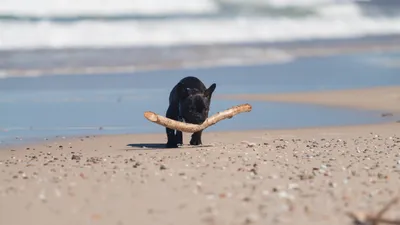
Variety in exercise improves engagement: different routes, sniff walks rather than pace walks, occasional off-lead time in safe areas, beach trips (with life jacket near water) and play sessions with known dogs all contribute to a mentally and physically stimulated adult dog.
Seniors (7+ years)
Exercise needs gradually reduce as French Bulldogs age, and joint health becomes more relevant. Older dogs may have stiffened joints, reduced airway function relative to their younger selves, or emerging health conditions that affect stamina.
The principle of watching the dog applies even more strongly: shorter, more frequent walks at the dog’s chosen pace. Swimming (life-jacketed) may become more comfortable than walking for dogs with joint pain. Warm weather restrictions become more stringent as thermoregulation efficiency decreases with age.
Mental stimulation: an underused tool
Physical exercise is not the only way to tire a French Bulldog. Mental effort is metabolically significant and behaviorally valuable, and for a breed with airway limitations, it provides stimulation without respiratory demand.
Puzzle feeders and Kongs. Feeding part of the daily ration through a puzzle feeder or frozen Kong (food stuffed and frozen) extends mealtimes and engages problem-solving behaviour.
Sniff walks. A walk where the dog is allowed to stop and smell whatever they want, at their pace, for as long as they want, provides far more mental stimulation than a brisk twenty-minute march around the same route. Nose work is cognitively demanding.
Training sessions. Short training sessions of five to fifteen minutes engage focus and mental effort. French Bulldogs can be surprisingly trainable when the motivation is right; the training guide covers techniques that work with the breed’s particular approach to cooperation.
Interactive play. Tug, fetch in the garden, hide-and-seek with toys, and similar games provide short bursts of physical and mental engagement in a controlled environment.
Equipment
Harness, always. A neck collar applies pressure to the throat during pulling or when the lead is taut, which worsens BOAS symptoms and is uncomfortable for any dog with breathing restrictions. A Y-shaped harness that distributes pressure across the chest is the standard for Frenchies. Fit it so there is room for two fingers at any point.
Water on every walk. Even on mild days, carry water for the dog. A collapsible water bowl or a bottle with an attached bowl takes seconds to use and prevents unnecessary dehydration, particularly after exercise.
Paw care. Hot pavements, salt in winter and varied terrain affect paw condition. Checking paws after walks and using paw balm if needed is straightforward preventive care. The French Bulldog paws guide covers interdigital cysts, allergy-related paw licking, hot pavement risk and the full preventive routine.
On water specifically, can French Bulldogs swim? covers the real drowning risks, life jacket requirements and how to make water safely enjoyable for the breed. For the full picture on what Frenchie ownership involves daily, the temperament and lifestyle guide covers exercise alongside companionship, heat management and apartment living in detail. For a dedicated breakdown of summer safety, walk timing, cooling strategies and heatstroke emergency response, the French Bulldogs in hot weather guide covers all of this in one place. For a specific emergency reference if you suspect heatstroke is developing, the heatstroke guide covers first aid steps and when to call the vet. On equipment, the choice of harness is not incidental for this breed: the best harness for French Bulldogs guide covers why collar walking worsens BOAS, what the Y-front design does differently and how to fit a harness correctly. For winter-specific walk adjustments, temperature limits, paw care after gritted pavements and what coats actually help, the French Bulldogs in cold weather guide covers the practical detail. For apartment owners managing the breed’s exercise needs without a garden, the apartment living guide covers how to meet those needs in a flat context. For teaching reliable recall so off-lead exercise is safe in open spaces, the recall guide covers the full training method including proofing in distracting environments. For the post-exercise zoomie bursts that many Frenchies experience, what causes them, whether they are normal and the one scenario where they need monitoring, the zoomies guide covers the full picture. Weight has a direct effect on exercise tolerance and BOAS severity in this breed; the French Bulldog weight guide covers healthy ranges and the impact of excess weight on breathing and activity. For exercise that involves a car journey, the restraint options, heat management and the travel sickness that is more common in brachycephalic breeds, the French Bulldog car travel guide covers the breed-specific practical considerations.
Frequently asked questions
-
Most adult French Bulldogs do well with 20 to 40 minutes of walking per day, split across two outings. This is significantly less than many other breeds. Frenchies are not endurance dogs; their exercise needs are moderate, and the limiting factors are their compressed airways and sensitivity to heat rather than their fitness or willingness. More is not better for this breed: over-exercising a Frenchie causes respiratory distress rather than building fitness.
-
No, not sustained running. Frenchies can do short bursts of speed in the garden or during play, but they cannot safely sustain running alongside a jogging human. Their restricted airways cannot supply enough oxygen for sustained effort, and they risk overheating. They are also physically built for short bursts rather than endurance: short legs, front-heavy build and a tendency to tire quickly. If you want a running companion, a French Bulldog is the wrong breed.
-
The guidance used by the Kennel Club, RSPCA and most vets is not to walk dogs when the pavement is too hot for your bare hand (if you cannot hold your hand on the pavement for 5 seconds, it is too hot for paws). In practice, this means avoiding walks in direct sun from roughly 11am to 4pm in UK summer. French Bulldogs should not be exercised when air temperature exceeds approximately 20 to 22°C. Morning and evening walks in summer are the practical solution.
-
The general guideline for puppies is five minutes of walking per month of age, twice a day. A four-month-old puppy should have two 20-minute walks per day. This protects developing joints and growth plates from over-stress. Off-lead play in a garden or safe enclosed space is additional and does not need to be restricted in the same way because puppies self-regulate their intensity. Do not take puppies on long walks or runs; let them set the pace.
-
Mental stimulation is as valuable as physical exercise for French Bulldogs, and does not risk their airways. Puzzle feeders, Kong toys stuffed with food, scatter feeding (spreading food across the garden or a snuffle mat), training sessions, sniff walks (letting the dog choose pace and stop to smell everything), hide-and-seek games, and interactive play all provide stimulation. A fifteen-minute training session can be as tiring as a thirty-minute walk.
-
Frenchies can participate in some dog sports at a recreational level: beginners agility, nose work, trick training and casual rally are all appropriate. Competitive agility with fast running sequences and sustained effort is not suitable for the breed. Nose work and scent-based activities are particularly well-suited to Frenchies: they are mentally demanding, require no sustained physical effort and tap into the dog's natural instincts.