Contents
French Bulldogs and water: why they struggle to swim, the real drowning risks, how to keep them safe and what to look for in a dog life jacket.
French Bulldogs and water is a combination that requires more preparation and attention than it gets from most owners. These dogs are enthusiastic about water, particularly in hot weather when everything about the world is telling them to find something cool to lie in. The problem is that enthusiasm does not translate into swimming ability, and the breed’s anatomy creates a genuine drowning risk in water they cannot stand in.
The anatomy problem
A dog that swims well is, roughly speaking, long-bodied with legs long enough to paddle effectively and a head proportioned to sit naturally above the water surface when the body is buoyant. French Bulldogs are the opposite of this in several respects.
Front-heavy build. The Frenchie’s chest and shoulders are proportionally very large relative to the hindquarters. In water, this weight distribution means the front sinks faster than the back. A dog trying to keep the front end up while the nose is already at water level is in trouble.
Flat face. The flat muzzle means there is very little elevation between the chin and the top of the nose. In normal dog posture in water, the nose is a few centimetres above the surface. In a brachycephalic dog, the nose is at surface level when the body is at the same angle. Any downward tilt of the head, which happens when a dog tires, can submerge the nostrils.
Short legs. Effective paddling requires some length of leg to move water efficiently. Frenchie legs are short and the action generates relatively little propulsion.
BOAS. Most Frenchies have some degree of breathing restriction. Swimming demands rapid, efficient breathing. A dog that already has limited airway function has less reserve to manage the extra respiratory demand of staying afloat.
The result is that most French Bulldogs can stay at the surface for a short time with significant effort, but cannot sustain that effort for long. They are not swimmers in any meaningful sense.
What safe water access looks like
Safe water contact for a French Bulldog means controlled conditions where the risk of getting into depth they cannot handle is minimised.
Shallow paddling
Shallow water, belly height or below, where the dog can stand on the bottom with the head well clear of the surface, is the safest form of water access without a life jacket. A shallow stream crossing, a paddling pool, or the very edge of a calm beach where the water is consistently shallow are all appropriate.
The difficulty is that water depth changes. A river that is ankle-deep in one spot may be waist-deep two metres further along. A beach that seems shallow may have a sharp drop just beyond the break. Paddling without a life jacket requires active supervision and an awareness of the depth profile.
Life-jacketed water play
With a correctly fitted life jacket, water access can extend to deeper conditions safely. The jacket provides buoyancy that compensates for the Frenchie’s front-heavy sinking tendency and keeps the nose above the surface without the dog having to maintain constant effort.
Dogs wearing well-fitting life jackets can access paddling pools, shallow ponds and supervised beach swims at a level of safety that bare-swimming does not allow. The jacket does not eliminate risk, but it transforms the outcome of the most common accidents (loss of footing, misjudged depth, tiring) from potentially fatal to easily manageable.
Choosing a life jacket
Not all life jackets are designed for French Bulldogs, and an ill-fitting jacket provides false reassurance. French Bulldogs have an unusual body profile: very wide chest, short torso, short legs and a heavy head. A standard dog life jacket designed for a spaniel or labrador will not distribute buoyancy correctly or stay in place.
What to look for
Forward buoyancy. Given the front-heavy sinking tendency, a jacket with buoyancy concentrated around the chest and under the neck provides better correction than one with even distribution. Some Frenchie-specific jackets explicitly design for this.
Chest and belly fit. The jacket needs to fit snugly around the barrel chest without restricting the ribcage. Measure the broadest part of the chest (the circumference just behind the front legs) and compare carefully against the manufacturer’s size guide.
Top handle. A grab handle on the back of the jacket is essential for lifting the dog from the water quickly if needed. Without a handle, getting a panicking, wet Frenchie out of a pool safely is genuinely difficult.
Chin float or neck support. A float under the chin or supporting the neck keeps the face angled upward rather than forward-down. This is particularly important for brachycephalic breeds.
Buckle and strap security. A jacket that slips off or spins sideways in water is no protection. Look for double-adjustment straps and a belly strap as well as a chest strap.
Reflective strips. Useful for visibility in low light near water.
Lead attachment point. A ring or loop on the back of the jacket means you can clip a lead and maintain control in and out of the water.
Sizing
Measure:
- Chest girth: the widest circumference around the chest, just behind the front legs
- Back length: from the base of the neck to the base of the tail
- Weight
Use all three measurements against the manufacturer’s guide. For French Bulldogs, chest girth is usually the limiting measurement; do not size down on this to get a smaller jacket overall.
Trial the jacket on dry land before any water contact. The dog should be able to breathe freely, move all four legs without restriction and hold the head comfortably. Adjust straps until the jacket sits snugly without being tight enough to restrict movement or breathing.
Beach safety
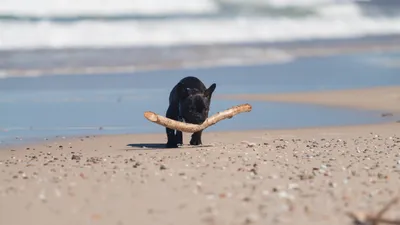
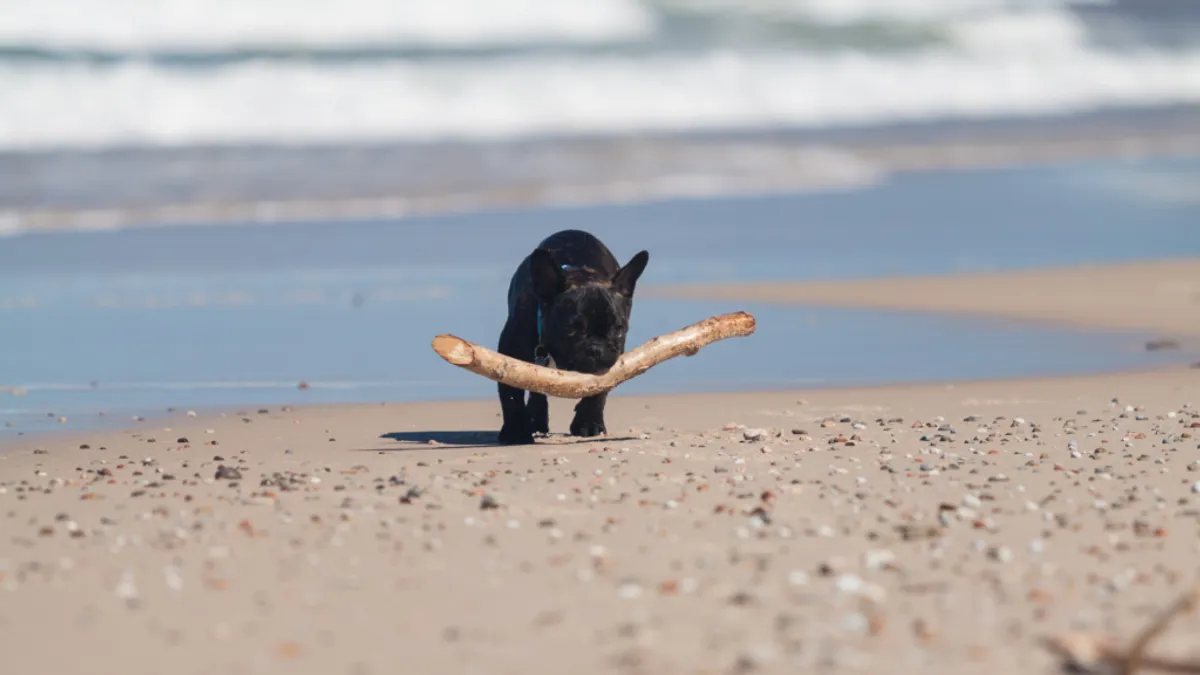
The beach is one of the most enjoyable environments for a Frenchie in summer, and one of the most hazardous near water. Specific considerations:
Tides and currents. The sea changes. A shallow, calm area at low tide may be significantly deeper and have stronger currents as the tide comes in. Check tide times and know which direction the tide is running before letting your Frenchie near the waterline.
Waves. A medium-sized wave at an angle can knock a dog off its feet. A Frenchie in the surf without a life jacket that gets knocked over by a wave is in immediate trouble. At active surf beaches, life jacket use is particularly important.
Hot sand and paws. French Bulldogs are heat-vulnerable, and hot sand heats the paws quickly. Wet sand at the waterline is cooler. Avoid walking on dry sand in peak sun.
Overheating. Beach environments in summer (sun, heat, physical activity) are one of the highest-risk settings for Frenchie overheating. The exercise guide covers heat management, and the health guide describes the signs of heatstroke.
Pool safety at home
An unguarded garden pool is a serious hazard for any French Bulldog. Pools typically have vertical or near-vertical sides, meaning a dog that falls in cannot get itself out regardless of swimming ability. Without exit steps or a ramp, the dog will tire and drown.
If you have a garden pool and a French Bulldog:
- Fence the pool to prevent access when unattended
- Consider a pool alarm (available for garden pools) that detects sudden disturbance of the water
- Fit a ramp or pool exit steps and train the dog to use them
- Never leave the dog unsupervised near the pool
A dog left unattended in a garden with pool access for thirty minutes is at genuine risk if they fall in.
After water
After any water contact, rinse the dog’s coat and skin folds with clean fresh water to remove chlorine, salt or river contaminants. Pat dry thoroughly, particularly in the skin folds where moisture sits and creates the conditions for bacterial or yeast infection. The grooming guide covers skin fold care in detail.
Check for signs of ear water entry: shaking the head, pawing at the ears, or unusual odour from the ears in the days after swimming may indicate water has entered the ear canal.
Monitor breathing for any unusual sounds or increased effort over the hours following significant water activity.
Frequently asked questions
-
French Bulldogs can move in water and some will actively try to swim. The problem is that their body shape makes it very difficult to do so effectively or safely. Their heavy, front-weighted torso, short legs, flat face and barrel chest mean they tend to be front-heavy in water, angling downward at the nose. This makes keeping the head above water exhausting. Most Frenchies will sink rather than swim if left unsupported in water deeper than they can stand in. A life jacket is not optional near open water.
-
Many Frenchies enjoy water, particularly paddling in shallow water on hot days. The appeal of cooling down overrides any instinctive wariness, and some will wade enthusiastically into paddling pools, streams and the sea. The issue is not reluctance but overconfidence: a dog that happily paddles in shallow water will not necessarily recognise when it has moved into water too deep to stand in. Supervision near water needs to be active, not background.
-
A good French Bulldog life jacket should have: buoyancy foam that supports the front of the body (where a Frenchie sinks), a secure chest and belly fit that suits the breed's wide chest and short torso, a top handle for lifting the dog from the water, reflective strips for visibility, and a ring for a lead attachment. The fit is critical: a jacket designed for a labrador will not fit a Frenchie's proportions. Measure chest girth and back length before buying and check the manufacturer's sizing guide for brachycephalic breeds.
-
Paddling in water up to belly height, where the dog can keep all four paws on the ground and the head is well clear of the surface, is generally safe with active supervision. Anything beyond that, where the dog might lose footing or need to keep themselves afloat, requires a life jacket. Many owners use a life jacket for all water contact as a simpler rule. Rivers and the sea carry additional risks (current, waves, tides) that make a life jacket appropriate even in apparently shallow areas.
-
A small, shallow paddling pool (under 20 to 30cm deep) is one of the safest ways for a Frenchie to enjoy water. They can cool down effectively, stay on their feet and the containment means they cannot drift into deeper water. Always supervise, and empty the pool when finished: a dog that tips into a full paddling pool while you are inside is at risk if they cannot right themselves. Paddling pools are particularly useful in summer, given the breed's vulnerability to heat.
-
Get them out immediately. If your dog goes into a swimming pool, pond or river unexpectedly, retrieve them at once using the handle on their life jacket if wearing one, or by supporting their torso from underneath. Once out, keep them horizontal and warm. Check for signs of water inhalation: persistent coughing, laboured breathing, blue or pale gums. Any of these signs warrant immediate veterinary attention; secondary drowning (where water causes respiratory distress hours after the event) is a real risk even in dogs that seem fine immediately after.